
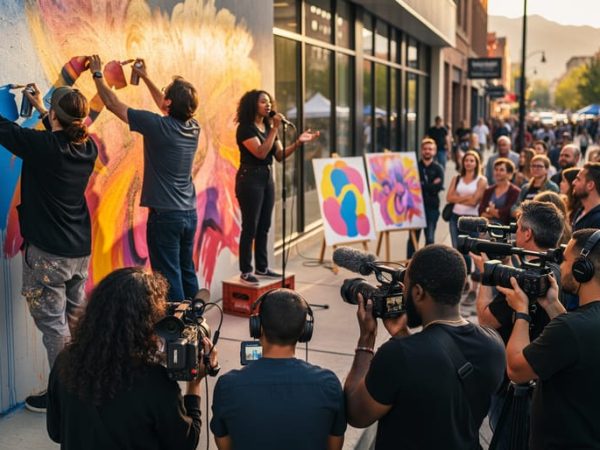
Every summer, something transformative happens in Salt Lake City. Artists reclaim parking lots, performances spill into streets, and voices that rarely find mainstream platforms suddenly command attention. The Urban Arts Festival, now in its fourth decade, transforms downtown into a sprawling laboratory where creative expression meets community activism, where muralists work alongside spoken word poets, and where the simple act of gathering becomes a statement about who gets to shape public space.
For Canadian filmmakers and cultural organizers watching from across the border, this festival offers more than inspiration. It provides a blueprint. How do you build an event that genuinely serves marginalized communities rather than tokenizing them? What does it look like when festival programming centers Indigenous artists, LGBTQ2S+ creators, and newcomer voices not as special interest categories but as the foundation itself?
Salt Lake City’s model proves instructive precisely because it operates in an unexpected context. Utah’s conservative reputation makes the festival’s radical inclusivity all the more striking. When thousands gather to celebrate queer poets, Palestinian visual artists, and Black musicians in a state often associated with cultural homogeneity, you’re witnessing what focused cultural activism can achieve.
The festival’s structure holds lessons for Canadian cities grappling with similar questions about representation and access. Free admission removes economic barriers. Dedicated youth programming nurtures the next generation of storytellers. Artist residencies create sustained relationships rather than one-off transactions. Documentary filmmakers have found particularly fertile ground here, capturing stories that emerge when communities control their own narratives.
This isn’t about copying another city’s festival wholesale. It’s about understanding how urban arts platforms can catalyze genuine cultural change, then adapting those insights to distinctly Canadian contexts.
What Makes Salt Lake City’s Urban Arts Festival Different
The Urban Arts Festival in Salt Lake City didn’t emerge from a corporate boardroom or a municipal tourism strategy. It started in 1996 when a small collective of artists wanted to reclaim downtown streets as canvases for creative expression that the city’s traditional galleries wouldn’t touch. That origin story still shapes everything about the festival three decades later.
Walk through the festival today and you’ll notice what’s missing: entry fees, velvet ropes, curated exclusivity. The festival sprawls across several downtown blocks each June, transforming ordinary pavement into exhibition space where anyone can encounter art without needing an invitation or a credential. This accessibility isn’t incidental. It’s the entire point.
The festival’s programming committee operates on a radically different model than most cultural events. Rather than selecting artists who fit predetermined themes or aesthetic standards, they actively recruit creators from communities that rarely see themselves reflected in Utah’s mainstream art scene. Indigenous artists from the Ute, Shoshone, and Paiute nations share space with immigrant storytellers from Latin America, East Africa, and Southeast Asia. LGBTQ+ artists whose work addresses identity and resistance display alongside disabled creators exploring accessibility through multimedia installations.
This isn’t diversity as decoration. The festival’s structure ensures underrepresented artists don’t just participate, they help shape what the festival becomes each year. Selection panels include community advocates and representatives from marginalized groups, not just established art professionals. The result is programming that challenges comfortable narratives and surfaces stories that dominant cultural institutions often ignore.
Consider how this contrasts with festivals that treat diversity as a single category to check off. Salt Lake City’s approach recognizes that a Polynesian muralist working in graffiti traditions, a transgender filmmaker documenting queer histories, and a refugee poet performing in their mother tongue aren’t interchangeable tokens. Each brings distinct perspectives that deserve space on their own terms.
The festival also refuses to separate “political” art from “real” art, understanding that for many creators, making work that reflects their lived experience is inherently an act of cultural resistance. When a Latinx collective stages a performance about immigration enforcement, or when Black artists create installations addressing police violence, the festival doesn’t dilute these messages or push them to margins. These voices occupy prime festival real estate because the organizers understand that art disconnected from social reality serves no one.
For filmmakers and cultural workers committed to authentic representation, this model offers a blueprint worth studying. It proves that festivals can prioritize both artistic excellence and radical inclusion without compromising either.
The Intersection of Film and Urban Arts
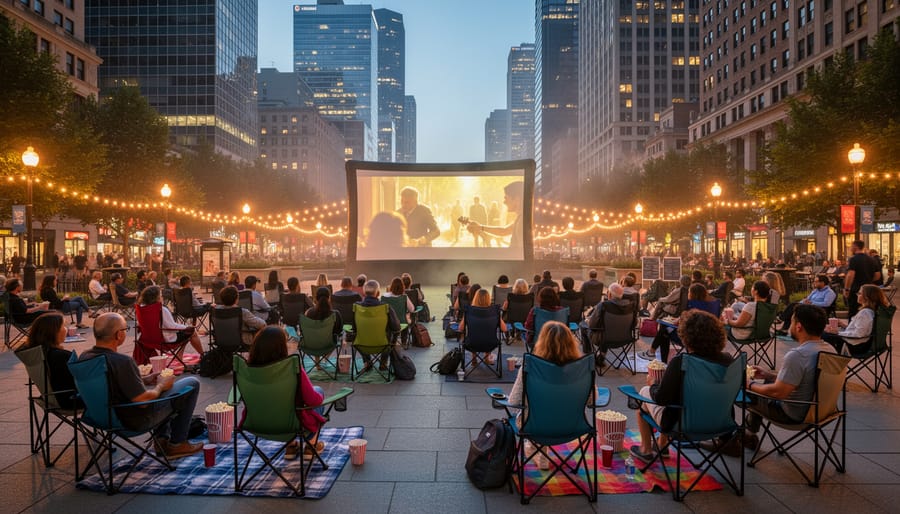
Film and cinema have become vital threads in the fabric of urban arts festivals, transforming these events from purely visual or performance-based gatherings into multimedia experiences that document, challenge, and celebrate community identity. At Salt Lake City’s Urban Arts Festival, the camera lens serves dual purposes: capturing the ephemeral magic of live street art and performance while also screening works that amplify marginalized voices and explore the social movements shaping our cities. Short films projected onto building facades become part of the urban landscape itself, while documentary screenings in festival tents offer intimate windows into the lived experiences of communities often invisible in mainstream media.
This relationship between film and urban arts festivals mirrors the documentary tradition in Canadian cinema, where filmmakers have long used their craft to illuminate the stories of Indigenous peoples, immigrant communities, and regional cultures fighting for recognition. Just as Canadian directors have turned their cameras toward neighborhood transformation, cultural reclamation, and grassroots activism, urban arts festivals provide ready-made subjects rich with visual dynamism and narrative urgency. The graffiti artist transforming a concrete wall, the spoken-word poet commanding a street corner stage, the community dancers reclaiming public space, these moments demand cinematic documentation because they represent cultural expression in its rawest, most authentic form.
Urban arts festivals also serve as testing grounds for experimental visual storytelling that breaks from conventional cinema. Silent Super 8 films projected during live musical performances, interactive video installations that respond to audience movement, and guerrilla screenings in unexpected public spaces all push the boundaries of how film communicates. These experimental approaches challenge the passive viewing experience and invite festival-goers to become co-creators in the storytelling process. For filmmakers committed to social justice and cultural understanding, urban arts festivals offer a blueprint for how cinema can step off the screen and into direct dialogue with the communities it seeks to serve.
Programming Highlights for 2026
Celebrating Local and Visiting Artists
The Urban Arts Festival Salt Lake City treats the interplay between local and visiting artists as creative fuel rather than programming obligation. Salt Lake City muralists, performance poets, and emerging filmmakers share stages and gallery walls with artists from Los Angeles, Portland, and international cities, transforming the festival grounds into a laboratory for cross-cultural exchange. A street artist from Salt Lake’s westside might collaborate on a live mural with a visiting painter from Vancouver, their different techniques and cultural references creating something neither could produce alone.
This mixing matters because it prevents the festival from becoming insular. When Austin-based spoken word artists perform alongside Utah Indigenous storytellers, audiences encounter perspectives that challenge their assumptions about Western art, urban identity, and whose stories deserve amplification. The festival’s curatorial approach deliberately pairs local voices with outside perspectives in ways that feel organic rather than tokenistic. Workshops led by visiting filmmakers give Salt Lake creators access to techniques and networks they might not encounter otherwise, while touring artists gain insight into communities they’d never reach through conventional gallery circuits.
The model mirrors effective festival storytelling strategies where geographic diversity strengthens rather than dilutes local identity. A filmmaker from Montreal screening documentary shorts about urban displacement finds common ground with Salt Lake artists addressing gentrification, proving that authentic creative exchange transcends borders when the work springs from genuine experience rather than performance of diversity.
Community Participation and Accessibility
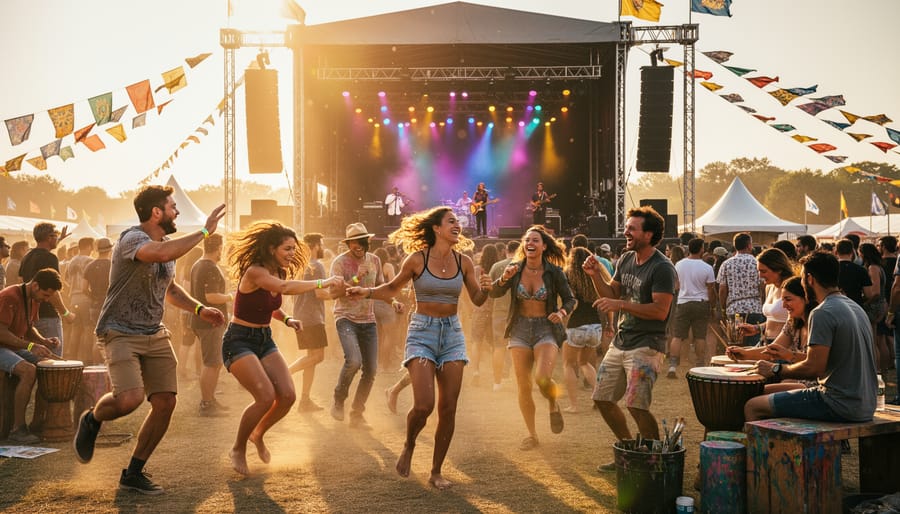
True accessibility in the arts means more than simply unlocking the gates. Salt Lake City’s Urban Arts Festival demonstrates this principle by dismantling economic, social, and creative barriers that typically separate audiences from art. The festival charges no admission fee, ensuring that a family’s financial situation never determines whether they experience world-class performances and installations. Kids 12 and under are free even for specialty workshops that normally carry costs, expanding access to hands-on creative education.
Beyond removing the price tag, the festival designs programming that welcomes families across generations. Interactive art installations invite children to touch, manipulate, and co-create rather than observe from behind velvet ropes. Parents discover that stroller-friendly pathways and nursing stations aren’t afterthoughts but intentional design choices. Evening performances start early enough for young attendees while late-night showcases serve adult audiences without excluding anyone.
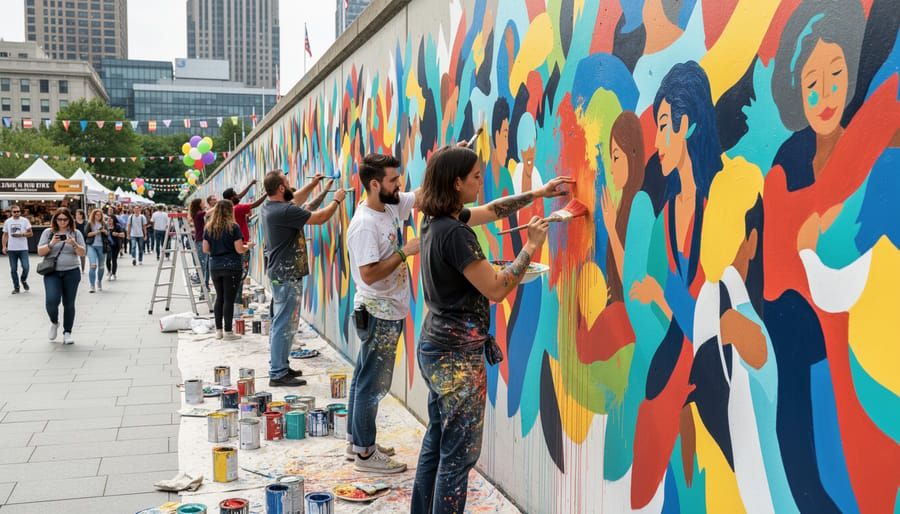
The festival’s most radical accessibility feature transforms community members into artists themselves. Open-call mural projects recruit neighbourhood volunteers to paint alongside established street artists. Poetry slams and spoken word stages accept sign-ups the day of performance, eliminating lengthy application processes that favour connected insiders. Filmmaking workshops lend equipment to participants who’ve never held a camera, then screen their work on the main stage days later.
This participatory model provides a platform for voices typically excluded from traditional arts institutions. A grocery clerk might share their immigrant story through performance. A teenager documents their neighbourhood on film. A retiree exhibits photography for the first time. The festival doesn’t just bring art to the community, it recognizes the community already contains artists waiting for permission to create.

Lessons for Canadian Cultural Festivals
Salt Lake City’s model offers a blueprint that Canadian cultural organizers can adapt to their own contexts. The festival’s commitment to removing financial barriers resonates deeply with Canadian values of accessibility and equity. While many Canadian film festivals already champion diverse voices, urban arts festivals in cities like Toronto, Vancouver, and Montreal could strengthen community ties by following Salt Lake’s lead: making admission free, programming across multiple neighborhoods rather than concentrating in downtown cores, and inviting community members to co-create content rather than simply consume it.
The emphasis on grassroots participation particularly aligns with Canada’s multicultural identity. Indigenous artists, immigrant communities, and regional creators often face systemic barriers to mainstream visibility. Salt Lake City demonstrates that when festivals actively recruit artists from underrepresented backgrounds and provide mentorship, technical resources, and prominent platforms, the entire creative ecosystem benefits. Canadian festivals could expand artist development programs, offer equipment loans to emerging creators, and establish partnerships with community centers in diverse neighborhoods to identify untapped talent.
Cross-disciplinary programming represents another transferable strength. Salt Lake’s integration of film, visual arts, music, and performance creates conversations across mediums that reflect how contemporary artists actually work. Canadian festivals often silo disciplines, but urban arts events could break down these boundaries. A documentary filmmaker might collaborate with a muralist, or a dancer could respond to a photographer’s work. This approach mirrors how reshaping our stories requires multiple perspectives and forms of expression working together.
The festival’s commitment to year-round community engagement, rather than operating as a single weekend event, offers lessons for sustainability. Canadian festivals could establish ongoing workshops, artist residencies, and public art projects that keep creative energy alive between annual gatherings. This transforms festivals from spectacles into genuine community infrastructure.
Documentation matters too. Salt Lake City archives performances, interviews artists, and creates educational resources that extend the festival’s impact beyond its dates. Canadian organizers could similarly build digital archives that preserve diverse voices and make content accessible to schools, libraries, and future researchers studying our evolving cultural landscape.
How Filmmakers Can Engage with Urban Arts Festivals
Urban arts festivals offer filmmakers far more than screening venues, they’re laboratories for collaboration, documentation, and creative risk-taking that can reshape your approach to storytelling. Whether you’re an established documentarian or just starting to explore how visual narratives intersect with community spaces, these festivals provide tangible pathways for engagement.
Start by researching the festival’s mission and past programming. Salt Lake City’s Urban Arts Festival, like many community-focused events, values authenticity and cultural resonance over polished production budgets. Review previous years’ film selections to understand what stories resonate with organizers and audiences. Does the festival prioritize local narratives? Do they spotlight social justice themes or experimental formats? This research shapes everything from your pitch to your networking approach.
- Connect with festival organizers months before submission deadlines through social media or email inquiries about their vision for upcoming programming.
- Attend the festival as a participant first if possible, observing how audiences engage with different formats and where gaps in storytelling exist.
- Develop project proposals that explicitly connect your filmmaking to the festival’s community values rather than treating it as just another screening opportunity.
- Submit work through official channels while also exploring partnership opportunities, offering to document the festival itself or lead filmmaking workshops for attendees.
- Follow up after the festival with organizers and fellow creators, building relationships that extend beyond a single event cycle.
Documentation presents its own opportunities. Many urban arts festivals welcome filmmakers who want to capture performances, installations, and community interactions. Propose a collaboration where your footage serves the festival’s archival and promotional needs while building your portfolio. These partnerships often grant you unprecedented access to artists and spaces while developing your observational storytelling skills.
The networking potential at these festivals rivals formal industry events. You’ll meet visual artists, musicians, performers, and cultural activists whose perspectives can transform your creative practice. Conversations happen organically between performances and in artist areas. Bring business cards, yes, but more importantly, bring genuine curiosity about how other creators approach their work.
For Canadian filmmakers specifically, studying festivals like Salt Lake City’s provides insights into how cross-border creative exchange enriches cultural understanding. The approaches to community engagement and inclusive programming translate directly to Canadian contexts, where festivals increasingly serve as platforms for Indigenous voices, immigrant communities, and marginalized storytellers. You can learn about more festivals working to reshape cultural narratives and apply those lessons to your own festival engagement strategy.
Emerging creators benefit especially from these festivals’ lower barriers to entry compared to major film festivals. Many accept first-time filmmakers, short formats, and experimental work that traditional venues might overlook. The informal atmosphere encourages risk-taking and authentic expression over commercial viability, creating space for the bold storytelling that defines truly transformative cinema.
Urban arts festivals serve as vital gathering spaces where creativity becomes a catalyst for social change. Salt Lake City’s festival demonstrates that when we create platforms for diverse voices, street artists alongside filmmakers, musicians beside poets, established creators working with emerging talent, we build something larger than entertainment. We construct communities rooted in shared expression and mutual respect.
The festival’s commitment to accessibility and participation offers a blueprint for cultural institutions everywhere. Free admission removes economic barriers. Open calls for artists expand who gets heard. Workshops transform spectators into creators. These aren’t peripheral details; they’re foundational choices that determine whether a festival truly serves its community or merely performs inclusivity.
For filmmakers and cultural activists, these festivals provide living laboratories for understanding how storytelling intersects with social justice. They reveal which narratives communities prioritize when given control over their own cultural spaces. They show how art functions not as decoration but as dialogue, documentation, and sometimes defiance.
Canadian cities already possess rich traditions of community-driven festivals and cultural celebrations. The question isn’t whether we need more festivals, but whether existing events genuinely reflect the diversity of voices in our communities. Support festivals that take risks on unconventional programming. Attend events featuring artists you’ve never heard of. Better yet, volunteer your skills or submit your work.
Cultural change happens one festival, one screening, one conversation at a time. Start with the one nearest you.